
Diplodon aethiops (I. Lea, 1860)
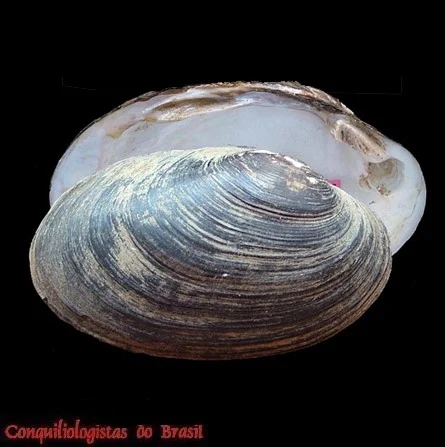
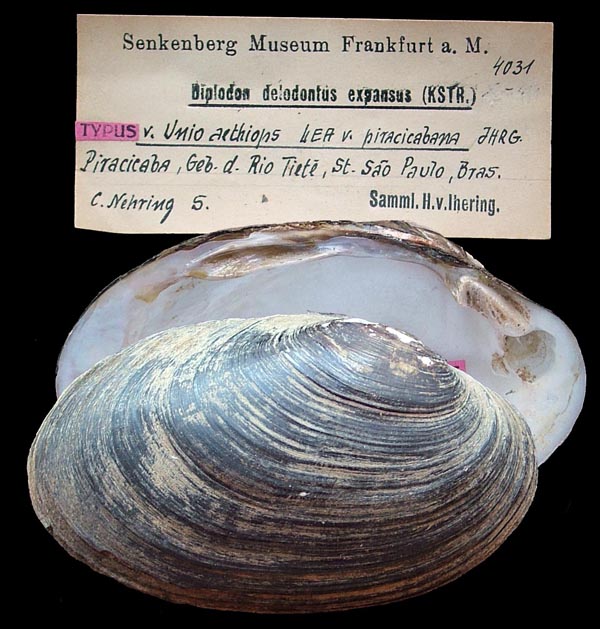
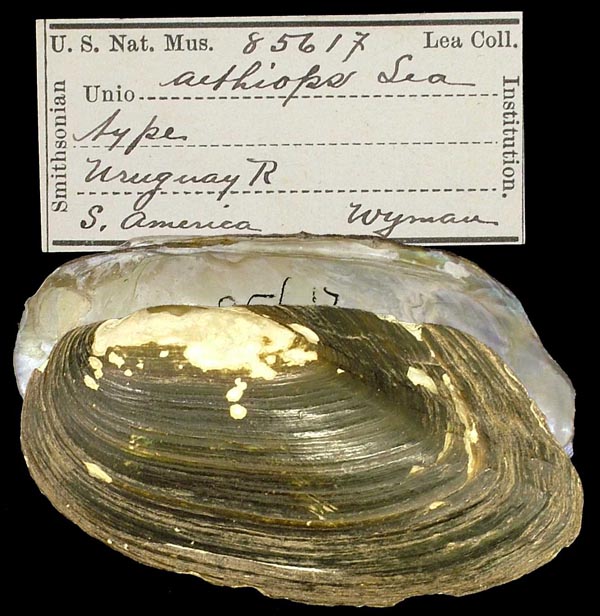
- (1-2) Senkeberg Museum Frankfurt: HOLOTYPE de Unio aethiops var. piracicabana Ihering, 1893 , SMF4031, Piracicaba, Rio Tietê, São Paulo; (3) National Museum of Natural History, Smithsonian Institution: HOLOTYPE de Unio aethiops I. Lea, 1860; lote USNM85817, Rio Uruguai
- Classe
- Bivalvia
- Família
- HYRIIDAE
- Tamanho
- nd
- Profundidade
- 0 - 10 m
- Habitat
- vive em fundos arenosos, enterrada ou sob ele e sob ou sobre pedras
- Localidade tipo
- Rio Uruguai
- Nome original
- Unio aethiops I. Lea, 1860
Distribuição
Ocorrência: Bacia do rio Paraná e rios costeiros no sul do Brasil e Uruguai
Sinônimos
- Diplodon (Diplodon) aethiops (I. Lea, 1860)
- Unio aethiops var. piracicabana Ihering, 1893
Comentários
Simone, 2006 considera como sinônimo de Rhipidodonta charruana (Orbigny, 1835), porém demais publicações consultadas e Molluscabase, 2024 consideram como espécie válida
Referências
Descrição original
- (como Unio aethiops I. Lea, 1860) Lea I. (1860). Descriptions of fifteen new species of Uruguayan Unionidæ. Proceedings of the Academy of Natural Sciences of Philadelphia. 12: 90-92 [after 13 March 1860; before 15 June 1860]., disponível online em https://biodiversitylibrary.org/page/26297237 — p. 91
- (como Unio aethiops var. piracicabana Ihering, 1893) Ihering, H. von. (1893). Najaden von S. Paulo und die geographische Verbreitung der Süsswasser-Faunen von Südamerika. Archiv für Naturgeschichte. 59 (1): 45-140., disponível online em https://www.biodiversitylibrary.org/page/6413908 — p. 102
- Pereira, D.; Mansur, M. C. D.; Duarte, L. D. S.; De Oliveira, A. S.; Pimpão, D. M.; Callil, C. T.; Ituarte, C.; Parada, E.; Peredo, S.; Darrigran, G.; Scarabino, F.; Clavijo, C.; Lara, G.; Miyahira, I. C.; Rodriguez, M. T. R.; Lasso, C. (2014). Bivalve distribution in hydrographic regions in South America: historical overview and conservation. Hydrobiologia. 735:15–44., disponível online em https://doi.org/10.1007/s10750-013-1639-x
- Simone, L. R. L. (2006). Land and Freshwater Molluscs of Brazil. Editora Gráfica Bernardi, FAPESP. São Paulo, 390 pp. página(s): 267
- Graf, D.L. & K.S. Cummings. [2024]. The Freshwater Mussels (Unionoida) of the World (and other less consequential bivalves). MUSSEL Project Web Site, http://www.mussel-project.net/. Accessed [29/06/2024]
Texto original da ficha (para comparação durante os testes)
CLASSE: BIVALVIA: ÁGUA DOCE
FAMÍLIA: HYRIIDAE
ESPÉCIE: Diplodon aethiops (I. Lea, 1860)
Tamanho médio: nd
Profundidade: 0 – 10 m
Habitat: vive em fundos arenosos, enterrada ou sob ele e sob ou sobre pedras
Ocorrência: Bacia do rio Paraná e rios costeiros no sul do Brasil e Uruguai
Localidade Tipo: Rio Uruguai
Nome original: Unio aethiops I. Lea, 1860
Sinônimos: Diplodon (Diplodon) aethiops (I. Lea, 1860); Unio aethiops var. piracicabana Ihering, 1893
Comentários: Simone, 2006 considera como sinônimo de Rhipidodonta charruana (Orbigny, 1835), porém demais publicações consultadas e Molluscabase, 2024 consideram como espécie válida
Fotos: (1-2) Senkeberg Museum Frankfurt: HOLOTYPE de Unio aethiops var. piracicabana Ihering, 1893 , SMF4031, Piracicaba, Rio Tietê, São Paulo; (3) National Museum of Natural History, Smithsonian Institution: HOLOTYPE de Unio aethiops I. Lea, 1860; lote USNM85817, Rio Uruguai
Fontes:
Descrição original: (como Unio aethiops I. Lea, 1860) Lea I. (1860). Descriptions of fifteen new species of Uruguayan Unionidæ. Proceedings of the Academy of Natural Sciences of Philadelphia. 12: 90-92 [after 13 March 1860; before 15 June 1860]., disponível online em https://biodiversitylibrary.org/page/26297237
página(s): 91
Descrição original: (como Unio aethiops var. piracicabana Ihering, 1893) Ihering, H. von. (1893). Najaden von S. Paulo und die geographische Verbreitung der Süsswasser-Faunen von Südamerika. Archiv für Naturgeschichte. 59 (1): 45-140., disponível online em https://www.biodiversitylibrary.org/page/6413908
página(s): 102
Pereira, D.; Mansur, M. C. D.; Duarte, L. D. S.; De Oliveira, A. S.; Pimpão, D. M.; Callil, C. T.; Ituarte, C.; Parada, E.; Peredo, S.; Darrigran, G.; Scarabino, F.; Clavijo, C.; Lara, G.; Miyahira, I. C.; Rodriguez, M. T. R.; Lasso, C. (2014). Bivalve distribution in hydrographic regions in South America: historical overview and conservation. Hydrobiologia. 735:15–44., disponível online em https://doi.org/10.1007/s10750-013-1639-x
Simone, L. R. L. (2006). Land and Freshwater Molluscs of Brazil. Editora Gráfica Bernardi, FAPESP. São Paulo, 390 pp. página(s): 267
Graf, D.L. & K.S. Cummings. [2024]. The Freshwater Mussels (Unionoida) of the World (and other less consequential bivalves). MUSSEL Project Web Site, http://www.mussel-project.net/. Accessed [29/06/2024]
Molluscabase: https://www.molluscabase.org/aphia.php?p=taxdetails&id=1362538