
Graptacme eborea (Conrad, 1846)
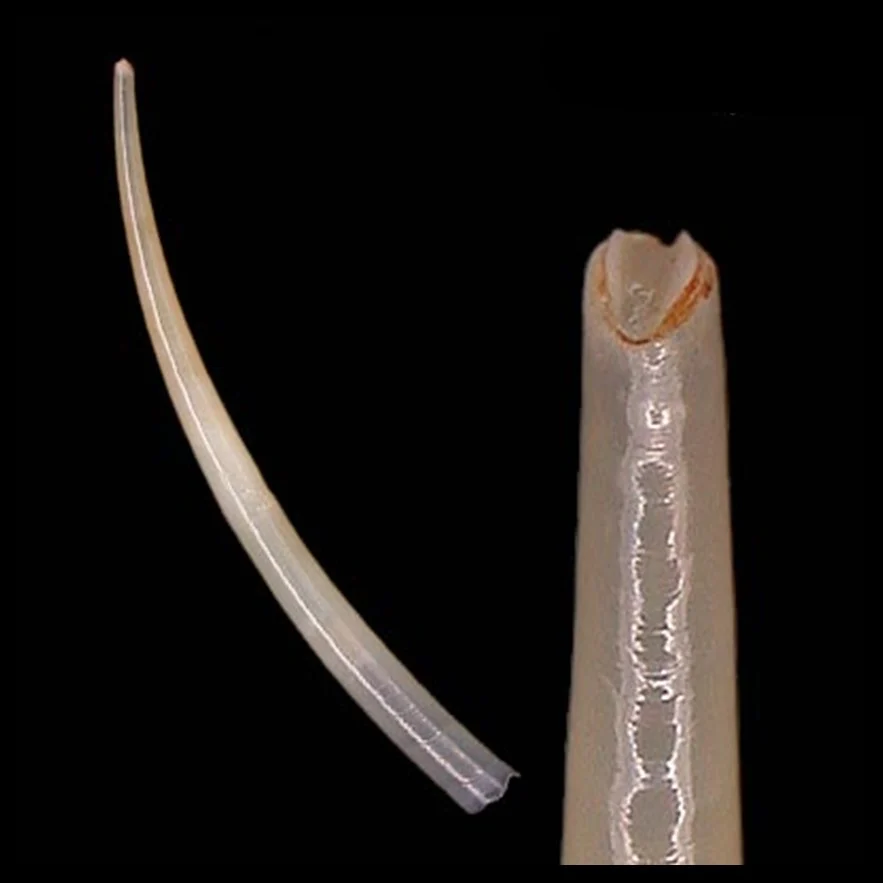
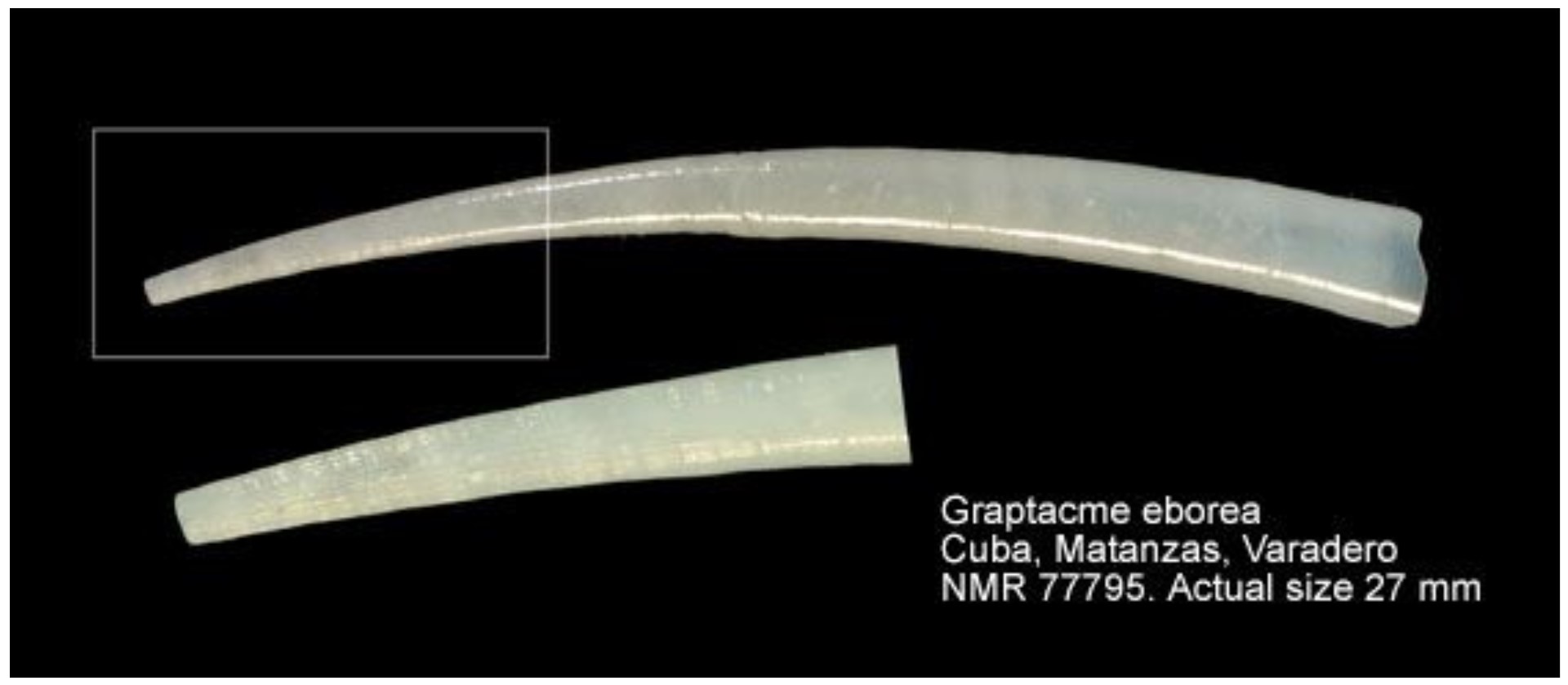
- (1) cortesia Femorale, 2011, Graptacme eborea (Conrad, 1846), Brasil, sem localidade específica; (2) Natural History Museum Rotterdam: Graptacme eborea (Conrad, 1846), NMR 77795, Cuba, Maranzas, Varadero, 2002, 27mm
- Classe
- Scaphopoda
- Família
- DENTALIIDAE
- Tamanho
- 25 - 35 mm
- Profundidade
- 5 - 195 m
- Habitat
- Lodo e areia - Vive em fundos lodosos ou arenosos
- Alimentação
- Carnívoro - Alimenta-se de outros animais
- Localidade tipo
- EUA, Florida, Tampa Bay
- Nome original
- Dentalium eboreum Conrad, 1846
Distribuição
No Brasil: Pará, Maranhão, Pernambuco, Rio Grande do Norte, Espírito Santo, Rio de Janeiro, Abrolhos, Fernando de Noronha and Atol das Rocas (Scarabino 1975, 1994, Rios & Barcellos 1980, Caetano et al. 2006)
Sinônimos
- Dentalium (Graptacme) eboreum Conrad, 1846
- Dentalium leptum K. J. Bush, 1885
- Dentalium matara Dall, 1889
Nova combinação
Steiner, G.; Kabat, A. R. (2004). Catalog of species-group names of Recent and fossil Scaphopoda (Mollusca). Zoosystema. 26 (4): 549-726., disponível online em https://sciencepress.mnhn.fr/en/periodiques/zoosystema/26/4/catalogue-des-noms-du-groupe-espece-de-scaphopodes-mollusca-recents-et-fossiles Kraeuter, J. N. 2009. Scaphopoda (Mollusca) of the Gulf of Mexico, Pp. 745–749 in Felder, D.L. and D.K. Camp (eds.), Gulf of Mexico–Origins, Waters, and Biota. Biodiversity. Texas A&M Press, College Station, Texas Souza, Leonardo & Araújo, Isabella & Caetano, Carlos. (2013). A commented list of Scaphopoda (Mollusca) found along the Brazilian coast, with two new synonymies in the genus Gadila Gray, 1847. Biota Neotropica. 13. 228-235
Referências
Descrição original
- (como Dentalium eboreum Conrad, 1846) Conrad, T. A. (1846). Descriptions of new species of fossil and Recent shells and corals. Proceedings of the Academy of Natural Sciences of Philadelphia. 3(1): 19-27, pl. 1., disponível online em https://www.biodiversitylibrary.org/page/1659288 — p. 27
- (como Dentalium leptum K. J. Bush, 1885) Bush, K. J. (1885). List of the shallow-water Mollusca dredged off Cape Hatteras by the “Albatross” in 1883. Annual Report of the U. S. Bureau of Fish and Fisheries. 1883: 579-590 [77-88 of Appendix D]., disponível online em https://www.biodiversitylibrary.org/page/30854825 — p. 586 [84]
- (como Dentalium matara Dall, 1889) Dall, W. H. (1889). Reports on the results of dredging, under the supervision of Alexander Agassiz, in the Gulf of Mexico (1877-78) and in the Caribbean Sea (1879-80), by the U.S. Coast Survey Steamer "Blake", Lieut.-Commander C.D. Sigsbee, U.S.N., and Commander J.R. Bartlett, U.S.N., commanding. XXIX. Report on the Mollusca. Part 2, Gastropoda and Scaphopoda. Bulletin of the Museum of Comparative Zoölogy at Harvard College. 18: 1-492, pls. 10-40., disponível online em http://www.biodiversitylibrary.org/item/25505 — p. 420
- Scarabino, V. 1994. Class Scaphopoda: 305-310, pl 105-107. in: Rios, E.C. Brazilian mollusks iconography. Fuundaçao Universidade do Rio Grande, Brasil
Texto original da ficha (para comparação durante os testes)
CLASSE: SCAPHOPODA : MARINHO
FAMÍLIA: DENTALIIDAE
ESPÉCIE: Graptacme eborea (Conrad, 1846)
Tamanho médio: 25 – 35 mm
Profundidade: 5 – 195 m
Habitat: Lodo e areia – Vive em fundos lodosos ou arenosos
Alimentação: Carnívoro – Alimenta-se de outros animais
Ocorrência no Brasil: Pará, Maranhão, Pernambuco, Rio Grande do Norte, Espírito Santo, Rio de Janeiro, Abrolhos, Fernando de Noronha and Atol das Rocas (Scarabino 1975, 1994, Rios & Barcellos 1980, Caetano et al. 2006)
Localidade tipo: EUA, Florida, Tampa Bay
Nome original: Dentalium eboreum Conrad, 1846
Sinônimos: Dentalium (Graptacme) eboreum Conrad, 1846; Dentalium leptum K. J. Bush, 1885; Dentalium matara Dall, 1889
Fotos: (1) cortesia Femorale, 2011, Graptacme eborea (Conrad, 1846), Brasil, sem localidade específica; (2) Natural History Museum Rotterdam: Graptacme eborea (Conrad, 1846), NMR 77795, Cuba, Maranzas, Varadero, 2002, 27mm
Fontes:
Descrição original: (como Dentalium eboreum Conrad, 1846) Conrad, T. A. (1846). Descriptions of new species of fossil and Recent shells and corals. Proceedings of the Academy of Natural Sciences of Philadelphia. 3(1): 19-27, pl. 1., disponível online em https://www.biodiversitylibrary.org/page/1659288
página(s): 27
Descrição original: (como Dentalium leptum K. J. Bush, 1885) Bush, K. J. (1885). List of the shallow-water Mollusca dredged off Cape Hatteras by the “Albatross” in 1883. Annual Report of the U. S. Bureau of Fish and Fisheries. 1883: 579-590 [77-88 of Appendix D]., disponível online em https://www.biodiversitylibrary.org/page/30854825
página(s): 586 [84]
Descrição original: (como Dentalium matara Dall, 1889) Dall, W. H. (1889). Reports on the results of dredging, under the supervision of Alexander Agassiz, in the Gulf of Mexico (1877-78) and in the Caribbean Sea (1879-80), by the U.S. Coast Survey Steamer “Blake”, Lieut.-Commander C.D. Sigsbee, U.S.N., and Commander J.R. Bartlett, U.S.N., commanding. XXIX. Report on the Mollusca. Part 2, Gastropoda and Scaphopoda. Bulletin of the Museum of Comparative Zoölogy at Harvard College. 18: 1-492, pls. 10-40., disponível online em http://www.biodiversitylibrary.org/item/25505
página(s): 420
Scarabino, V. 1994. Class Scaphopoda: 305-310, pl 105-107. in: Rios, E.C. Brazilian mollusks iconography. Fuundaçao Universidade do Rio Grande, Brasil
nova combinação: Steiner, G.; Kabat, A. R. (2004). Catalog of species-group names of Recent and fossil Scaphopoda (Mollusca). Zoosystema. 26 (4): 549-726., disponível online em https://sciencepress.mnhn.fr/en/periodiques/zoosystema/26/4/catalogue-des-noms-du-groupe-espece-de-scaphopodes-mollusca-recents-et-fossiles
Kraeuter, J. N. 2009. Scaphopoda (Mollusca) of the Gulf of Mexico, Pp. 745–749 in Felder, D.L. and D.K. Camp (eds.), Gulf of Mexico–Origins, Waters, and Biota. Biodiversity. Texas A&M Press, College Station, Texas
Souza, Leonardo & Araújo, Isabella & Caetano, Carlos. (2013). A commented list of Scaphopoda (Mollusca) found along the Brazilian coast, with two new synonymies in the genus Gadila Gray, 1847. Biota Neotropica. 13. 228-235
Molluscabase: https://molluscabase.org/aphia.php?p=taxdetails&id=344508